Screen time is one of the most anxiety-inducing topics in modern parenting. The forums are full of conflicting advice, the research is presented in alarming headlines, and somehow it has become a measure of what kind of parent you are. This post is an attempt to cut through all of that sharing what the Montessori approach actually says, what UK guidance now recommends, and what our day genuinely looks like without screens in it.
What Montessori Actually Says About Screens
Here is something worth knowing upfront: Dr Montessori never said a word about screens. She died in 1952, long before television was a parenting concern, let alone tablets or smartphones.
She was a scientist who looked at the world through a lens of curiosity — and arguably, she would have wanted to observe children using digital devices before making any firm decisions about them. Moonkie
What she did say clearly was that young children learn best through real, hands-on, sensory experience. She described the “absorbent mind” as the young child’s extraordinary ability to learn simply by interacting with their environment — and argued that to flourish, this absorbent mind needs real things: to touch, taste, climb, build, carry, pour, and explore. Reachformontessori
The Montessori concern about screens is not moral. It is developmental. Screens offer a two-dimensional experience that tends to be passive — lacking the tactile feedback, movement, and deep concentration that hands-on, real-world experiences provide. Reachformontessori
The question Montessori educators ask is not “are screens bad?” but simply: does this serve the child’s development right now? For a toddler at 18 to 24 months, the honest answer is usually that a bowl of water, a walk outside, or ten minutes with a wooden spoon offers more than a screen does. Not because screens are wrong, but because the alternatives are genuinely so rich at this age.
Montessori philosophy is not anti-technology — it is pro-appropriateness. Technology becomes part of the Montessori approach once children have the foundational sensory, motor, and social-emotional development to engage with it purposefully, which is typically in the elementary years. Speech Blubs
What UK Guidance Now Recommends
This is genuinely timely. In March 2026 — just weeks ago — the UK government released updated, evidence-backed screen time guidance for children under five. The guidance states that children below the age of two should not be exposed to screens at all, except for brief video calls with family members. For children aged two to five, daily screen time should be limited to no more than one hour. Fishtown Montessori
The recommendations also advise against screen use during mealtimes and in the hour before bedtime, and ask parents to watch content together with children rather than using screens as a solo activity. Fast-paced social media content, certain types of animation, and AI-driven tools are specifically advised against for this age group. Fishtown Montessori
One finding from the research behind this guidance is worth highlighting. Children might learn to copy words from a screen, but they need two-way interactions with a real person to learn how to use those words to communicate. This aligns directly with the Montessori emphasis on real interaction over passive input — and it is particularly relevant during the language explosion that happens between 18 and 24 months. The Toddler Playbook
The research also found that using screens to manage or reduce tantrums may not be effective over time and could be associated with increased reliance on digital devices for emotional regulation. Fishtown Montessori
Our Honest Experience: We Just Haven’t Got Round to It
Here is what our reality actually looks like.
We have not introduced screens (not television, not tablets, not audio-only devices) and the reason is straightforward: we have not found a need for them yet. That is all. It is not a strong philosophical stance and it is not something we feel superior about. The alternatives have simply been enough.
When our toddler is unsettled, we go outside. Even for fifteen minutes, even in a Bolton drizzle, the combination of fresh air and movement resets things in a way that is almost remarkable. A short walk, the park, the back garden — outdoor time is consistently the most effective tool we have.
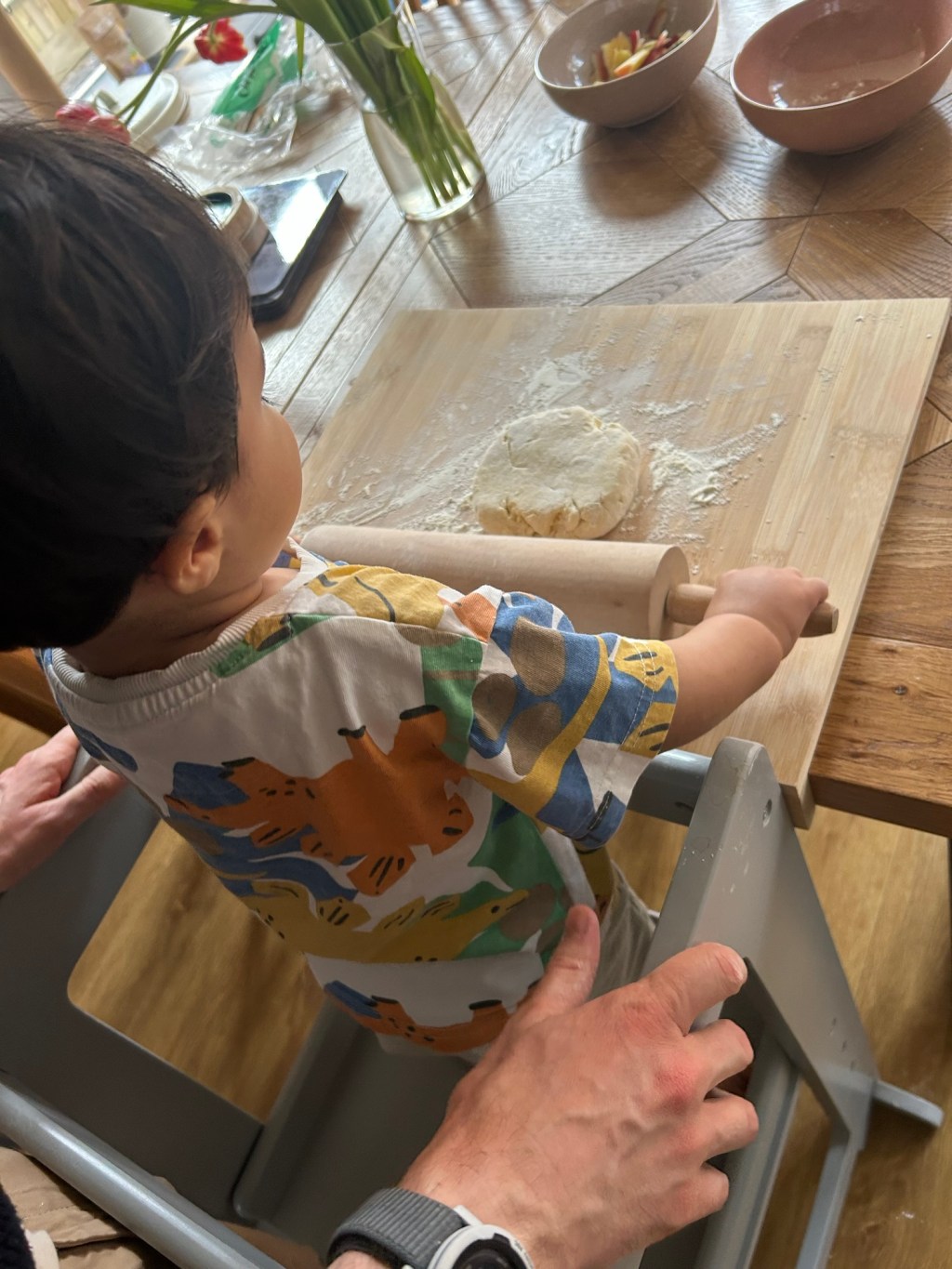
When we need a few minutes to function, we fall back on practical life. Bringing our toddler into whatever we are doing — wiping the table, watering a plant, transferring something between two bowls — keeps them occupied and involved without any screens required. It takes more patience than handing over a tablet, but it works.
When they want to play independently, they have a small selection of toys and materials on their shelf that rotate regularly. Because there are not many of them and they change often enough to feel fresh, they hold attention far better than a room full of options would.
None of this is because we have some perfectly curated Montessori existence. It is because at this age, the real world is genuinely more interesting to a toddler than a screen tends to be — and we have leaned into that rather than away from it.
What to Do Instead of Screens: What Actually Works at 18 to 24 Months
If you are trying to reduce screen time or simply looking for things that actually hold a toddler’s attention, here is what works for us on the days that are hard.
Go outside: Even briefly. Even in the rain. Puddles, sticks, pigeons, puddles again. The sensory richness of the outdoors at this age is unmatched by anything indoors.
Practical life: Give them a job. Wipe the table, water a plant, stir something in a bowl, post objects through a hole in a box. Real tasks with real purpose keep an 18-month-old absorbed in a way that toy play sometimes does not.
Water: A bowl of water on the kitchen floor on a towel, with a few cups and a spoon. This is the most reliably absorbing screen alternative we have found. It holds attention for a surprisingly long time and requires nothing to set up.
A treasure basket: A small basket of interesting household objects — a wooden spoon, a shell, a large pebble, a piece of fabric, a small mirror. Swap items in and out every few days. No batteries, no charging, no content to approve.
Their own toys, with fewer of them: Counter-intuitively, fewer toys on the shelf leads to more engagement with each one. Too many options is as overwhelming for a toddler as it is for an adult standing in front of Netflix.
The Part Nobody Says Loudly Enough
Screens are not a moral failing. Parents who use them are not doing something wrong. The research points to concerns with high and regular screen use displacing sleep, outdoor play, and face-to-face interaction and not with the occasional episode of something calm and age-appropriate.
The Montessori perspective that is most useful here is not actually about screens at all. It is about observation. Notice what your toddler gravitates toward. Notice what leaves them calm and what leaves them dysregulated. Notice what fills their attention genuinely versus what simply keeps them quiet.
For us, screens have not come up as something we need at least not yet, anyway. That may change. When it does, we will approach it the same way we approach everything else in Montessori: with observation, intention, and no particular guilt either way.

Leave a Reply