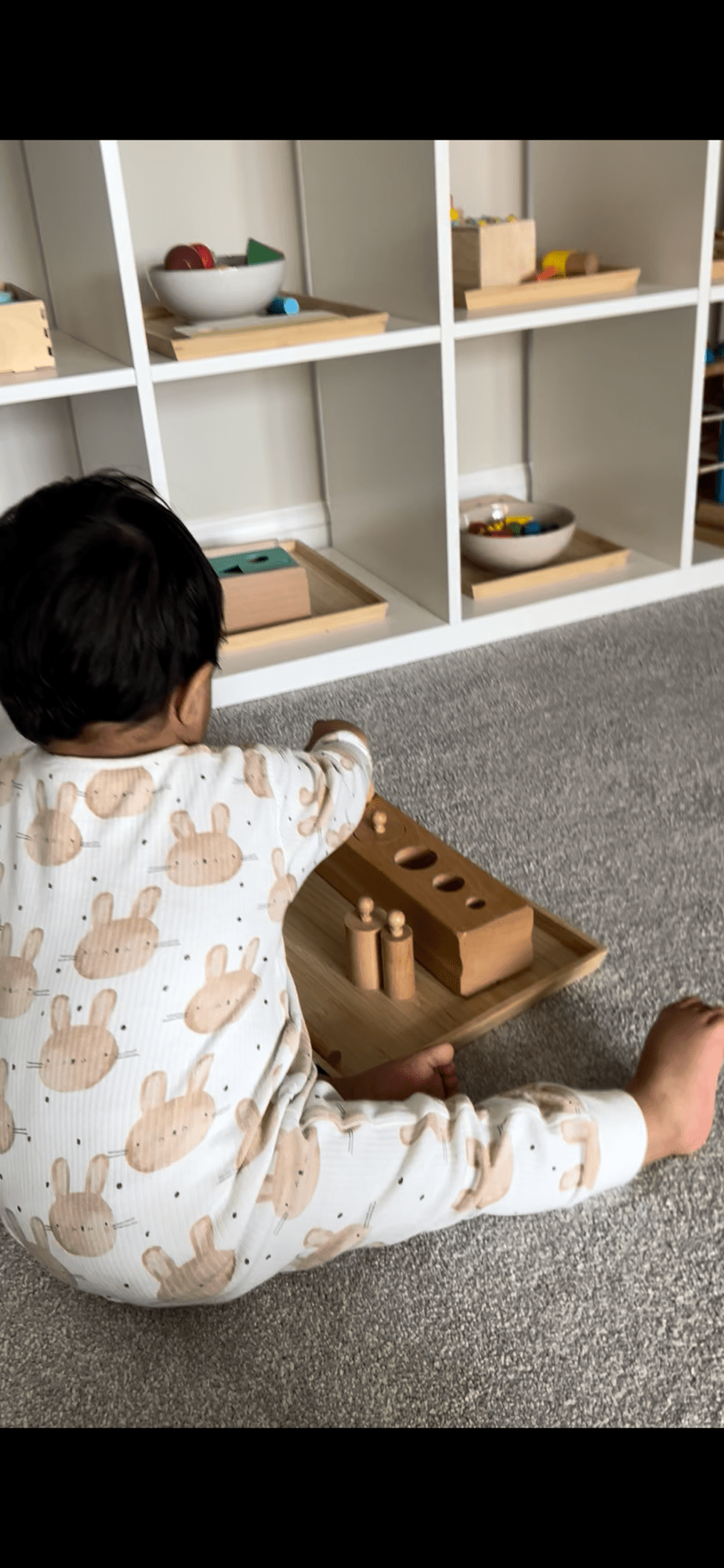
If you’ve landed here after falling down a Montessori rabbit hole at midnight, surrounded by beautiful Pinterest shelves you’ll never recreate — this post is for you.
Starting Montessori at home felt overwhelming to me too. The wooden toys, the perfectly organised shelves, the toddlers serenely spooning lentils into bowls. It looked like something that required a lot of money, a lot of space, and a personality I definitely don’t have.
But here’s what nobody tells you upfront: Montessori at home isn’t about any of that. It’s a way of seeing your child and it costs nothing to start.
This is my beginner’s guide to Montessori at home, written as a mum who is figuring it out in real time with an 18-month-old, a small living room, and an IKEA shelf that cost £40. Everything in this post is something we’ve actually tried. Nothing requires a Pinterest-worthy home.
What Is Montessori, Really?
Dr Maria Montessori was an Italian physician in the early 1900s who did something radical: she actually watched children, rather than telling them what to do. What she observed was that children are natural learners — deeply motivated, curious, and capable of far more than adults typically give them credit for.
Her guiding phrase was simple: “Help me to do it myself.”
That’s it. That’s Montessori in six words.
The goal isn’t a child who needs you for everything. It’s a child who discovers through daily experience that they are capable. The role of the parent isn’t to teach or direct, but to set up an environment where the child can explore, make choices, and figure things out on their own terms.
Montessori is not a product. It’s not a toy brand. It’s not an Instagram aesthetic. It’s a way of respecting your child as a whole person, right from the start.
Five Core Ideas That Actually Matter at Home
Before getting into activities, it helps to understand the ideas behind them. These are the five principles that have genuinely changed how I parent and not because I read them in a book, but because once I understood them, so much of my toddler’s behaviour started to make sense.
1. The Prepared Environment:
The “prepared environment” is one of those Montessori terms that sounds more complicated than it is. All it means is: your home should be set up for your child, not just for you.
In practice, this looks like low shelves where toys are visible and accessible. Books stored at toddler height. A small hook by the door for their coat. A step stool at the bathroom sink so they can wash their hands without being lifted.
The point is independence. When a child can reach their own things, get their own cup, choose their own book – they don’t need to ask you for everything. That matters enormously for their confidence, and honestly, it matters for your sanity too.
You don’t need to redesign your whole house. Even one low shelf changes the dynamic.
2. Follow the Child:
This principle asks you to observe before you intervene. What is your toddler drawn to? What do they return to again and again?
Most toddlers are captivated by the everyday tasks we take for granted like carrying things from room to room, opening and closing containers, whatever’s happening in the kitchen. That fascination isn’t random. It’s a signal, telling you exactly what they’re ready to learn next.
Montessori activities aren’t picked from a list and handed to a child. They grow out of what that particular child, at that particular moment, is interested in. Following the child means trusting those signals.
3. Sensitive Periods:
Dr Montessori observed that children go through windows of time when they are especially receptive to learning certain things. These are called sensitive periods, and they’re not arbitrary — they’re driven by what’s happening developmentally in the brain.
Between 18 and 24 months, your toddler is in a sensitive period for:
- Language: Their vocabulary is starting to explode. Single words, then two-word combinations. They’re absorbing everything you say.
- Order: They want the same book, the same route, the same sequence. This isn’t stubbornness; it’s their brain building a map of the world.
- Movement: They need to climb, carry, run, and use their whole body. This is cognitive development, not just physical.
Knowing this helps you stop fighting these urges and start working with them.
4. Independence over convenience
This one is the hardest, and I say that as someone who has wrestled wellies onto a determined toddler when we were already ten minutes late.
The Montessori approach asks you to let your child try even when it’s slower, messier, and more effortful than just doing it yourself. Putting on shoes. Carrying their own bag. Wiping up a spill.
Every time a child manages something independently, they build a belief in their own capability. Every time we swoop in and do it for them, we accidentally send the message that they can’t.
Slowing down is the hardest part of Montessori. It’s also the most important.
5. The Absorbent Mind:
From birth to age six, children have what Montessori called an “absorbent mind” a sponge-like capacity to absorb language, culture, movement, and habits from their environment, seemingly without effort.
This is not pressure. It’s permission to relax. You don’t need to formally teach your toddler anything. You just need to give them a rich, calm environment to soak up and to narrate your world as you move through it together.
What Montessori at Home Actually Looks Like at 18–24 Months
Here’s where it gets practical. This is what our week actually looks like messy, imperfect, and genuinely Montessori.
Practical life activities are the cornerstone of Montessori for toddlers. They’re not cute extras, they’re the main event. And the best part? They’re just your daily life, with your toddler involved.
Practical Life: Your Most Powerful Tool
In the kitchen:
- Washing fruits and vegetables before meals. A low bowl of water, some potato (for example), a small brush.
- Wiping the table after meals. A small damp cloth, their own job. It takes four times longer than if I just did it and that’s exactly the point.
- Pouring their own water from a small pitcher into their cup. Start with tiny amounts. Expect spills. Keep a cloth nearby and resist the urge to take over.
- Washing dishes with you or at least standing on a step stool feeling very important while you do it.
Around the house:
- Watering a plant with a small watering can. Even a recycled small milk bottle works fine.
- Putting their shoes by the door. Same spot, every time and it feeds that sensitive period for order beautifully.
- Carrying the (light) shopping bag from the car. They will be insufferably proud of themselves.
- Unloading/loading the dishwasher.
Fine Motor and Concentration
These activities support hand-eye coordination, which is developing rapidly at this age.
- Transferring: Two small bowls and a spoon. Move dried pasta, pom-poms, or small stones from one to the other. That’s it. They’ll do it for longer than you expect.
- Posting: An old plastic container with a hole cut in the lid. Post coins, small blocks, whatever fits. A classic for good reason.
- Simple puzzles: Two or three piece wooden puzzles with knobs. Look for ones with real photographs rather than cartoon images as montessori materials favour reality over fantasy at this age.
- Threading: Large beads on a thick lace. Great for concentration and fine motor control.
Language
At 18–24 months, the most powerful language tool you have is narration. Just talk.
- Name everything on a walk. “That’s a conker. That’s a puddle. That’s a double-decker. That’s a wheelie bin.” No quizzing, no “what’s that?” Just give the word and move on.
- Read books where you point and name, rather than reading every word on the page. Follow their gaze, not the text.
- Sing the same songs repeatedly. Repetition isn’t boring to a toddler it’s deeply satisfying. It’s how they learn.
- Let them finish sentences they know. Pause before the last word of a familiar song and wait. That moment of anticipation is doing a lot of work.
Movement
Don’t underestimate how much your 18–24 month old needs to move their whole body. This is developmental, not just energy to burn.
- At the park: Step back a little. Let them figure out how to get up the climbing frame without immediately reaching for them. Watch what they’re trying to do.
- At home:
- Cushion obstacle courses.
- Carrying a basket of laundry.
- Moving a stack of books from one room
- A Pikler triangle is the gold standard Montessori climbing frame but a sturdy sofa and a pile of cushions does similar work for free.
Do You Actually Need Montessori Materials?
Honestly? Not really. Not to start.
The Montessori approach favours real objects over plastic toys so wooden spoons, metal bowls, real cups, glass (yes, breakable glass, because natural consequences are a teacher). Most of this you already own.
If you do want to invest in a few things, here’s where to start:
- A low shelf, IKEA’s Kallax or Trofast ranges work perfectly. Rotate a small number of activities on it and swap them out every week or two when interest fades.(This has been the best investment for us so far).
- A step stool so your toddler can reach the sink and feel included in kitchen life.
- A small pitcher for independent water pouring at mealtimes.
- Simple wooden puzzles that available on Amazon UK, often for under £10.
- We have a front facing bookshelf from Etsy but also have books in bags from Ikea in different places in the house and both works fine for us.
That’s genuinely all you need to begin. The rest can grow as you go.
Where to Start Today
One thing. That’s all.
Pick one thing in your home and move it to your toddler’s level. A book. Their cup. A small basket of objects they can explore freely. Put it somewhere they can access without asking you.
Then watch what they do with it.
That quiet observation, noticing what draws them in and what they return to, is where Montessori actually begins. Not the shelf. Not the toys. Just paying attention to your child.

Leave a Reply