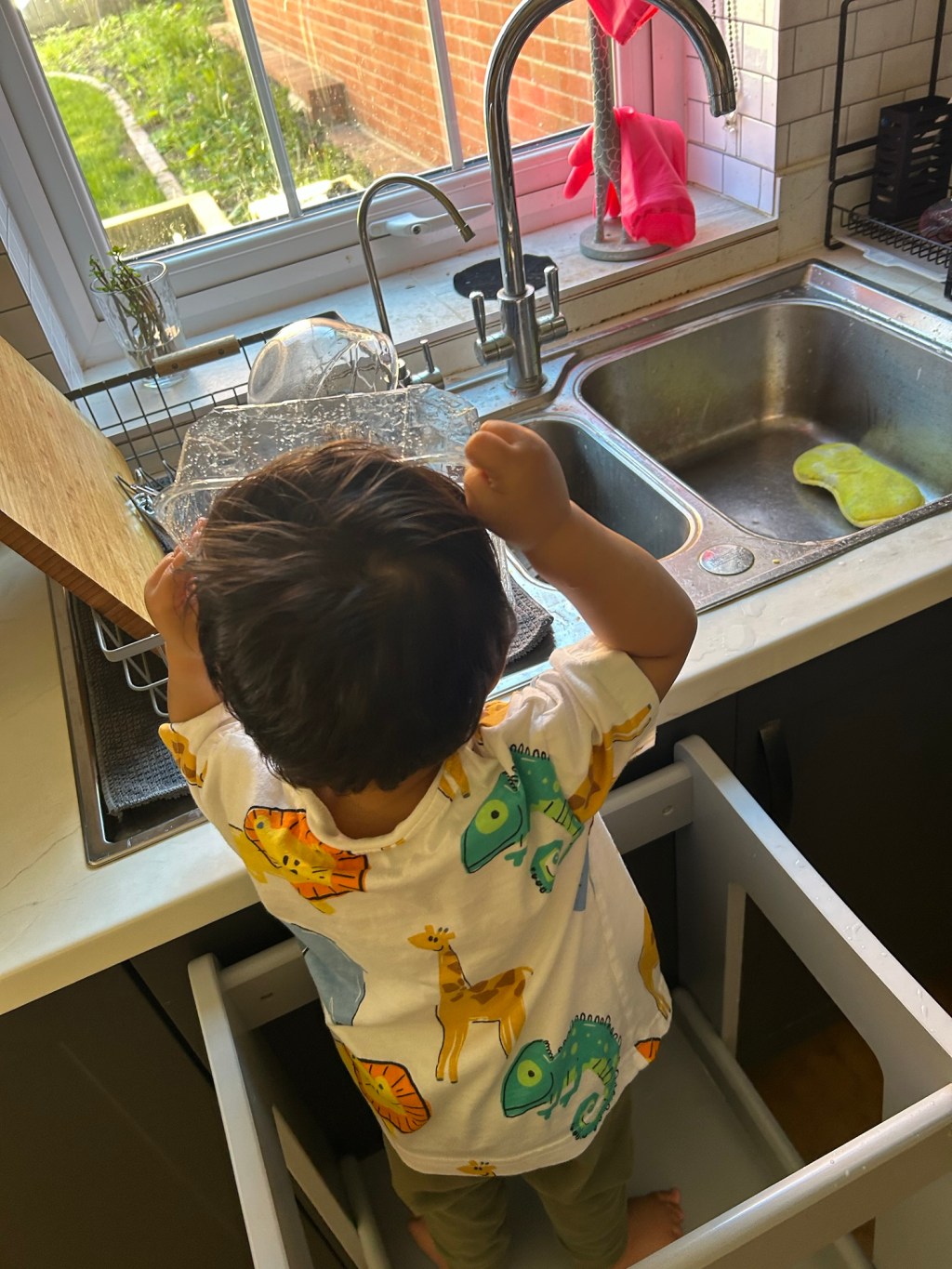
You do not need to buy anything for this post to be useful. Every activity here uses something already in your home like your kitchen, your recycling bin, your garden, your bathroom. Grab your toddler and pick one.
From the Kitchen Cupboards
1. The Transferring Bowl: Two bowls. One large spoon. Fill one with dried pasta or rice, show your toddler how to spoon it into the empty bowl, then walk away. They will do this for an astonishing amount of time. Developmentally it is building hand-eye coordination and concentration but honestly it just looks like they are doing the washing up.
2. The Pouring Jug: A small jug or measuring cup with a tiny amount of water, a cup, and a tray underneath. Show them how to pour slowly. Say nothing when it spills. Hand them a cloth. Repeat daily until they can do it at the breakfast table without you holding your breath.
3. The Posting Box: Take an old plastic tub or an empty cereal box. Cut a hole in the lid. Post coins, dried pasta shapes, or small blocks through the hole. The simpler the better. This is the same principle as expensive Montessori posting materials, made from your recycling bin in about thirty seconds.
4. Washing the Fruit: A low bowl of water, a small brush, and whatever fruit or veg needs washing before dinner. Grapes are brilliant for this. Your toddler gets real kitchen involvement, you get clean fruit, everyone wins.
5. Stirring a Bowl: Water, a bowl, a wooden spoon. Or flour and water. Or dried oats. The specific contents matter less than the act of stirring with intention. Narrate as they go: “round and round, slowly, look at it move.” Language and fine motor in one go.
6. Lid Matching: Collect your Tupperware and take the lids off. Mix them up. Show your toddler how to find the matching lid and press it on. This is more challenging than it looks and deeply satisfying when it clicks into place.
From the Laundry
7. Pegging: Wooden pegs and a low rail, the edge of a laundry basket, or a piece of string tied between two chair legs. Show them how to open and close the peg, then hand them small flannels or baby socks to peg up. The pinching motion is excellent fine motor work and they will feel genuinely useful.
8. Sorting Socks: Tip a pile of clean socks onto the floor. Show them how to find the matching pair and fold them together. They will not match them perfectly. That is absolutely fine as the sorting and handling is the point, not the result.
9. Carrying the Laundry Basket: A small basket of clean washing, carried from the bedroom to wherever it needs to go. Toddlers at this age love carrying heavy things and it is gross motor development dressed up as a chore, and they will feel enormously proud of themselves.
From the Recycling Bin
10. Stacking Tins: Empty tins with smooth edges make brilliant stacking towers. They are heavier than wooden blocks, which makes them more interesting and more challenging. The crash when the tower falls is also, let’s be honest, the best part.
11. Nesting Boxes: Cardboard boxes of different sizes like cereal boxes, tea boxes, biscuit tins nested inside each other and pulled apart again. This teaches size discrimination and spatial reasoning in the most low-tech way imaginable.
From the Bathroom
12. Sink Water Play: Step stool, small amount of water in the sink, a cup and a sponge. Squeezing, pouring, and splashing all build the same skills as expensive water table toys. Add a small amount of washing-up liquid for bubbles and it becomes even better.
13. The Treasure Basket: A basket filled with safe, interesting bathroom objects like a clean hairbrush, a small mirror, a wooden comb, a flannel, a cotton reel, a loofah. Let your toddler explore freely. No direction needed. This is entirely child-led sensory exploration.
From Outside
14. The Nature Collection Walk: A small bag and permission to collect whatever they find on the ground. Conkers, pebbles, sticks, leaves, fallen petals. Back home, tip them out and sort them, line them up, or put them in a bowl of water. The collecting, carrying, and organising is all rich Montessori work.
15. Digging: A patch of garden, a pot of soil, or even a tray of compost. A spoon is the only tool needed. Digging, filling, patting down, and starting again. Simple, absorbing, and very very muddy. Accept the mud. It washes off.
A Few Things Worth Knowing
Keep activities out one or two at a time, not all at once. Too many choices is overwhelming at this age and a small number of well-chosen activities gets far more engagement than a room full of options.
Rotate things weekly. An activity that was ignored last Tuesday will often be met with fresh interest when it reappears after a week away.
If your toddler uses the activity differently than you intended, let them. Following their lead is the whole point.

Leave a Reply