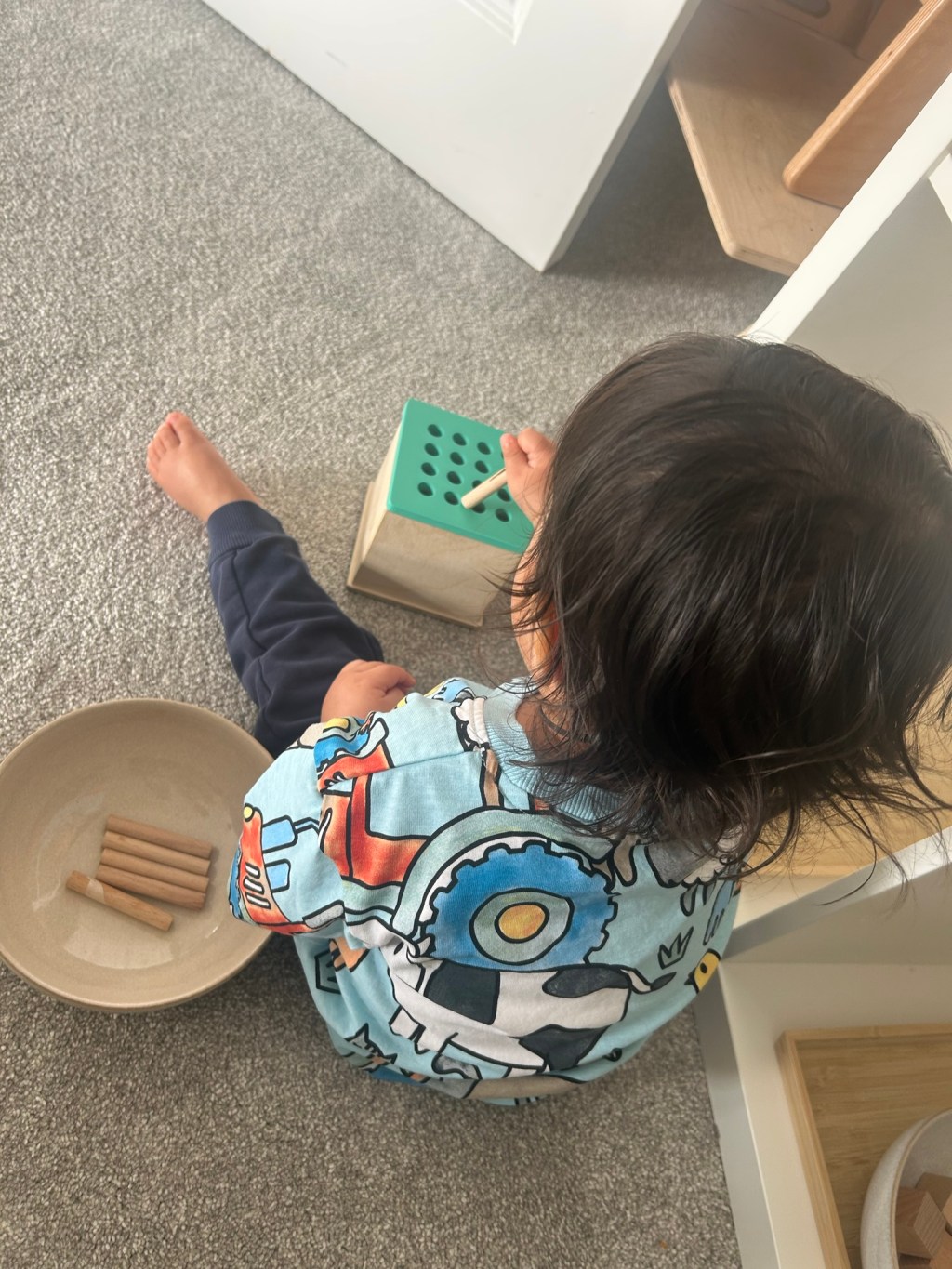
One of the things I’ve noticed most in toddlerhood is repetition.
My son will choose the same work again and again. Place the ring. Remove it. Place it again. Carry the basket. Return it. Repeat. Sometimes for many minutes, sometimes throughout the day.
From the outside, it can look repetitive. Predictable. Even boring.
But for the child, repetition serves a clear purpose.
In Montessori, repetition is understood as part of a sensitive period for movement and coordination. During this time, the child is naturally driven to repeat actions in order to refine them. Each repetition strengthens the connection between the brain and the body. Movements become more precise. What was once effortful becomes controlled.
This is how the hand develops. And in Montessori, the hand is deeply connected to the development of the mind.
Through repetition, the child is not only learning how to complete a task. He is building coordination, concentration, and confidence. He is also building independence. With each successful repetition, he begins to trust his own ability.
I’ve noticed that when he first begins a work, there is more observation and adjustment. He moves more slowly. But after repeating it many times, his movements become calm and assured. He no longer needs to pause in the same way. The movement becomes part of him.
Repetition also brings a sense of order. The child understands the full cycle of the work — choosing it, using it, and returning it. This predictability helps him feel secure in his environment.
 Exploringmontessori
Leave a comment