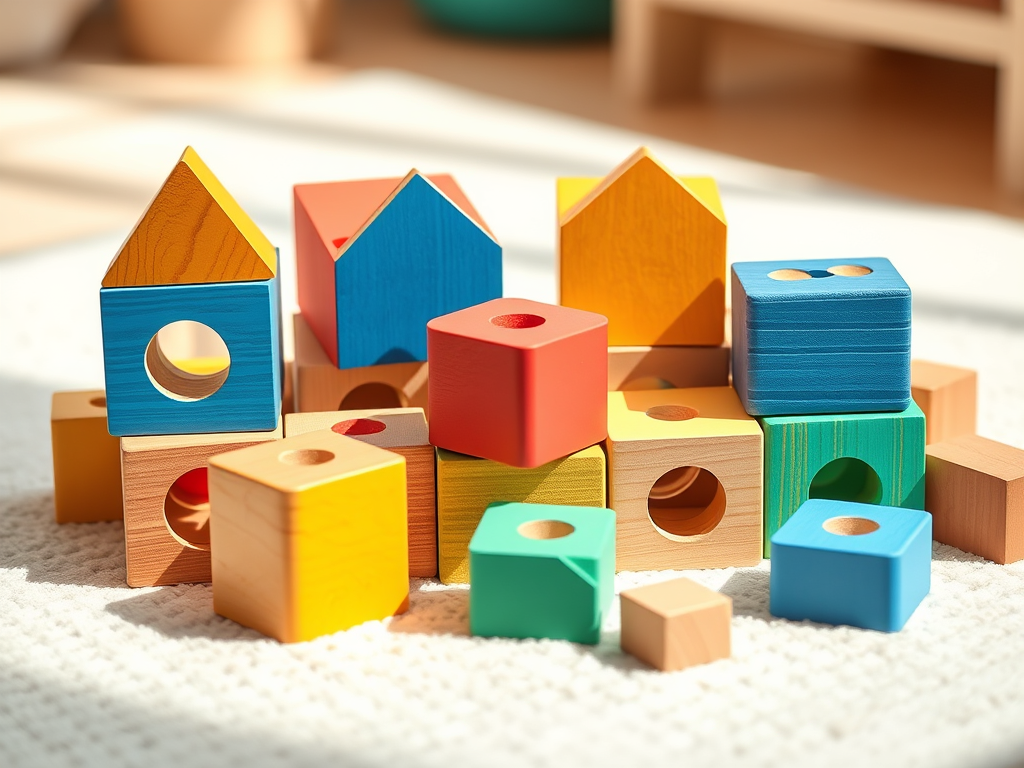
In a Montessori environment, blocks are far more than simple toys—they’re intentionally selected materials that nurture a child’s natural development. Their clean, open-ended design meets children right where they are, supporting everything from early sensory exploration to creative expression and collaboration.
Though often associated with older toddlers, blocks play an essential role starting in infancy. As a child grows, these unassuming wooden forms help build foundational skills—focus, coordination, balance, problem-solving, and even early social interaction.
0–6 Months: Awakening the Senses
What to Offer:
A single large grasping block or a smooth wooden cylinder.
Why It Matters:
In the earliest months, babies are just beginning to engage with the world. A simple wooden object encourages visual tracking, hand exploration, and tactile discovery—whether they’re reaching during tummy time or simply observing. These early interactions lay the groundwork for fine motor development.
6–12 Months: Exploration Through Repetition
What to Offer:
Small wooden cubes, lightweight cylinders, spools, rings, or other heuristic items safe for mouthing and banging.
Why It Matters:
This is a stage of intense exploration—babies are driven to grasp, mouth, drop, and bang objects over and over. These repetitive actions help strengthen hand–eye coordination and support sensory integration. Blocks that are safe and satisfying to handle offer just the right kind of feedback.
12–18 Months: The First Towers
What to Offer:
A small set of identical blocks—about 4 to 6 wooden cubes or rectangular prisms. We love Geo blocks and sensory blocks.
Why It Matters:
Around this age, toddlers often attempt to stack for the first time. These early experiments support concentration, balance, and understanding cause and effect. Even a single successfully placed block is a moment of triumph and learning.
18–24 Months: Structure and Intention
What to Offer:
A simple set of unit blocks with consistent proportions (like 1:2:4), along with flat planks or tiles for horizontal arrangements.
Why It Matters:
Children begin to show a desire for order—lining up blocks carefully, balancing them with precision, and beginning to build simple arrangements. This play supports spatial reasoning, pattern recognition, and a growing sense of purpose in their work.
24–36 Months: Real-World Representation
What to Offer:
A more complete unit block set, including architectural shapes like arches, columns, and ramps.
Why It Matters:
At this stage, block play becomes more intentional. Toddlers might announce they’re building a “house” or a “road”—not from fantasy, but from a concrete effort to represent the world they know. Their creations become more complex, often involving trial and error, emerging collaboration, and imaginative problem-solving.
Final Thoughts
Blocks are a quiet but powerful presence in the early years. With thoughtful presentation, they encourage persistence, creativity, and discovery—without batteries, screens, or overstimulation. When we offer the right kind of blocks at the right time, we’re not just giving our children something to do. We’re giving them tools to think, solve, and build—with confidence and joy.
 exploringmontessori
Leave a comment